Website Design Concept
West Coast Truss
Written for builders, this concept presents a Surrey and Kelowna truss manufacturer in the language of spans, drawings and sealed engineering.
This is a design concept: a website we designed as a proposal for West Coast Truss. It was not commissioned, and West Coast Media Solutions is not affiliated with West Coast Truss.
At a Glance
From plants in Surrey and Kelowna, West Coast Truss manufactures engineered roof and floor trusses, heavy timber and curved work, with engineering done in-house. Our one-page website concept speaks to builders, designers and framing crews: it explains four divisions, a catalogue of eight product lines, an on-staff engineering department, a five-stage process and two locations, then ends with a quote form that asks for company and project type.
- Project
- Design concept
- Sector
- Construction: engineered trusses and heavy timber
- Scope
- One-page concept with nine sections
- Highlights
- Truss drawing callout, product catalogue, five stages
- Concept
- View the concept
The Brief
Builders buying trusses care about spans, drawings, delivery and who signs off the engineering. The page had to answer in their language and make a quote request feel like part of the job.
- Speak to builders, designers and framing crews in the vocabulary of drawings and spans.
- Show manufacturing, engineering, products and field service as one accountable operation.
- Lay out every product line, from standard roof trusses to dome and elliptical ceilings.
- Collect the company name and project type with every quote request.
What We Designed
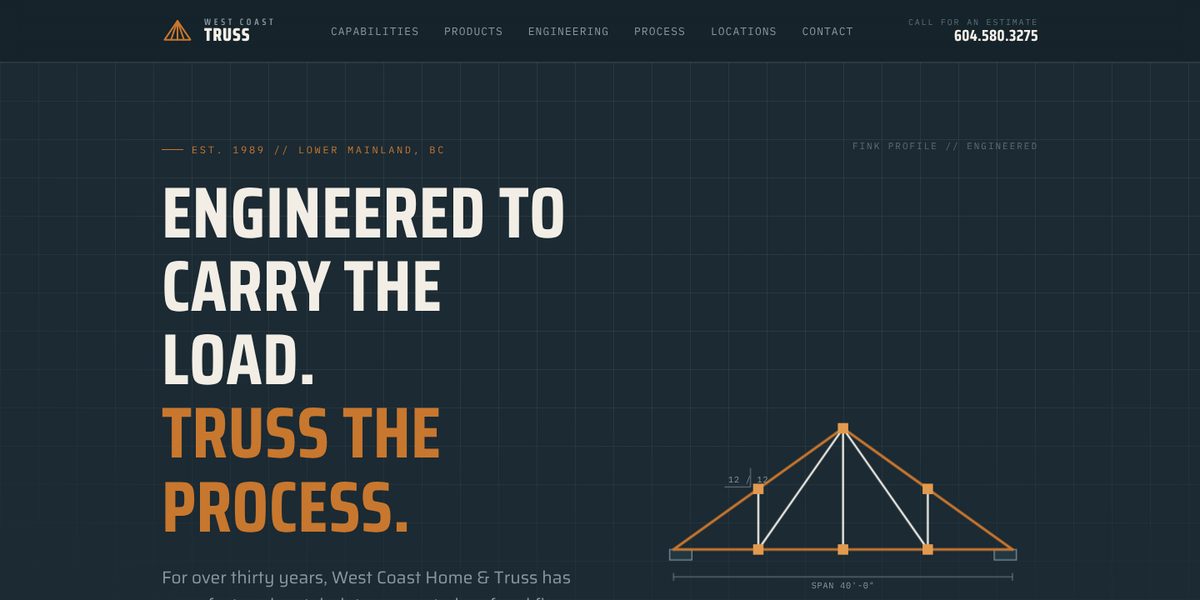
Saira Condensed capitals carry the headline, Engineered to carry the load. Truss the process., over a deep slate blue ground, with warm off-white text and copper buttons. IBM Plex Mono adds a drafting-room accent, and the opening screen carries a labelled Fink truss profile with its span and pitch noted, the way they would appear on a shop drawing. Small notations such as Est. 1989 // Lower Mainland, BC keep that voice going.
Section headings read like notes on a drawing: four divisions, one continuous build; built for the span, cut to the drawing; five stages, start to set. In turn they introduce the four divisions, the product catalogue, the engineering department, the process, long-standing relationships and the two locations, before the request a quote section. Numbered labels such as 01 / Manufacturing keep the sequence easy to follow.
Fink profile callout
A labelled truss profile in the opening screen notes the span and pitch, showing the product in the buyer's own terms.
Eight product lines
Roof, floor and metal web trusses, heavy timber, curved work, domes, fascias and laminated joists are each named.
Engineering on staff
Sealed drawings, site and geo-technical review, inspection and estimating sit in a section of their own.
Builder-ready quote form
Fields for company and project type sit beside the usual contact details, so trade enquiries arrive with context.
How We Achieved It
We organized the page around how a builder sizes up a supplier: capability first, then products, then engineering, then process and locations. The navigation follows the same order, and its last item reads call for an estimate, followed by the phone number. A strip of figures in the opening screen covers years in business, two plants, BC ownership and in-house engineering, so the basics are settled early.
The quote form asks for a company name and a project type as well as name, email, phone and a message, so every enquiry from a framing contractor or designer says who is asking and for what. The form is protected against spam. The footer gives the full company name, West Coast Home & Truss Ltd., along with the product lines and the Surrey head office.
Keep Exploring
More Case Studies
Want a Website Like This?
Let's talk about what your business needs, or start with a custom five-page website for $49 US a month.